
Deductible Expenses for an Osek Murshe (Sole Proprietorship in Israel) for 2026: Complete Guide
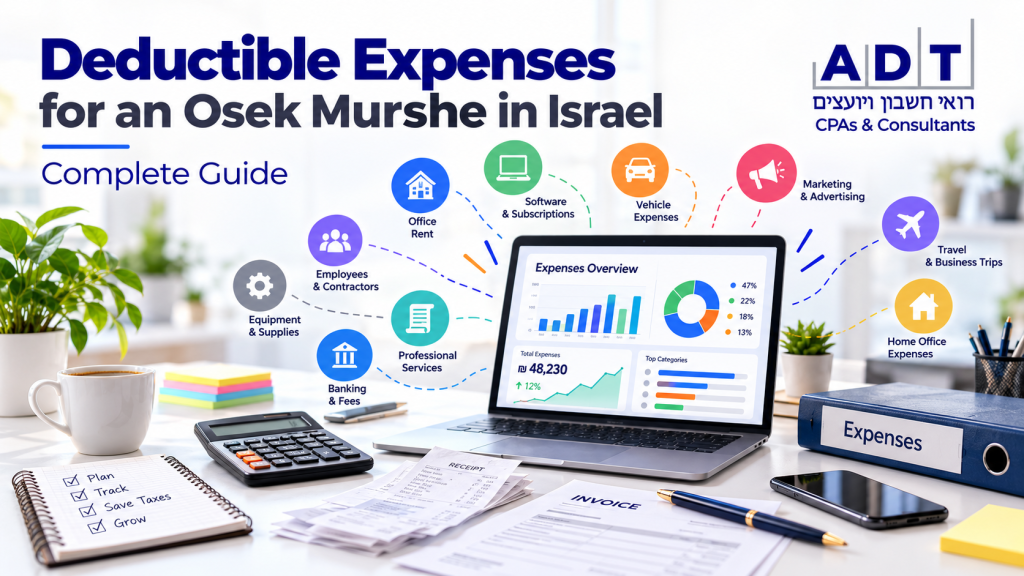
How Can You Reduce Your Tax Burden and Save Money for Your Business?
Running a business involves expenses — but not every payment you make is treated the same way for tax purposes.
For an Osek Murshe (VAT-registered self-employed business), business expenses can potentially provide two different tax benefits:
First, an eligible expense may reduce your taxable business profit for Income Tax purposes.
Second, where VAT was charged, you may also be able to deduct the input VAT (Mas Tsumot) from the VAT you collect from customers.
Understanding the difference is important because an expense may be deductible for Income Tax but have no deductible VAT, or only part of the VAT may be recoverable.
Under Section 17 of the Israeli Income Tax Ordinance, the general principle is that expenses incurred in producing business income may be deductible, subject to the specific rules and limitations that apply to different types of expenditure. Government of Israel
Osek Murshe vs. Osek Patur: What Is the Difference for Expenses?
For Income Tax, the basic rules governing deductible business expenses are generally the same whether you are an Osek Patur or an Osek Murshe.
The major difference is VAT.
An Osek Patur does not charge VAT to customers and also cannot deduct input VAT.
An Osek Murshe normally charges VAT on taxable sales and may deduct VAT paid on qualifying business purchases and expenses, subject to the VAT rules. The Tax Authority’s VAT guidance specifically covers the right of registered businesses to deduct input VAT. You can read more here: Government of Israel
A simple example
Suppose an Osek Murshe purchases business equipment for:
₪1,000 + ₪180 VAT
If the VAT is fully deductible:
- ₪180 may be claimed as input VAT
- ₪1,000 becomes the relevant cost for Income Tax purposes
- If the item is a capital asset, the ₪1,000 may be deducted over time through depreciation rather than immediately
The same purchase for an Osek Patur would generally include the unrecovered VAT as part of the cost.
Common Deductible Expenses for an Osek Murshe
| Expense | Income Tax | VAT | Important Notes |
|---|---|---|---|
| Office & Premises | |||
| Office / clinic / shop rent | Generally 100% | Usually 100% if VAT is charged | Must relate to the business |
| Arnona – business premises | 100% | No VAT | Municipal charges do not normally contain VAT |
| Electricity | 100% business premises | Generally 100% | Mixed-use home expenses require allocation |
| Water | 100% business premises | According to business use | |
| Cleaning | 100% | Generally 100% | Business premises |
| Repairs and maintenance | 100% if current expense | Generally 100% | Major improvements may be capitalized |
| Office supplies | 100% | Generally 100% | Paper, pens, folders, etc. |
| Printing and binding | 100% | Generally 100% | |
| Postage and courier services | 100% | Generally 100% where VAT charged | |
| Stock & Business Materials | |||
| Inventory purchased for resale | Deducted through cost of sales | Generally 100% | Subject to inventory accounting |
| Raw materials | 100% / cost of sales | Generally 100% | |
| Packaging | 100% | Generally 100% | |
| Consumable business materials | 100% | Generally 100% | |
| Computers, Equipment & Furniture | |||
| Computer | Usually depreciation | Generally 100% | Capital asset |
| Monitor / printer / equipment | Expense or depreciation | Generally 100% | Depends on nature and cost |
| Office furniture | Usually depreciation | Generally 100% | |
| Professional equipment | Usually depreciation | Generally 100% | E.g. medical, photographic or technical equipment |
| Small tools | Often current expense | Generally 100% | Depending on nature and useful life |
| Software & Digital Services | |||
| Accounting software | 100% | Generally 100% if Israeli VAT charged | |
| Microsoft 365 / Google Workspace | 100% | VAT depends on supplier/invoice | |
| Adobe / Canva / ChatGPT | 100% when business-related | VAT depends on supplier/invoice | |
| CRM software | 100% | Generally 100% where VAT charged | |
| Cloud storage | 100% | According to invoice | |
| Website hosting | 100% | Generally 100% where VAT charged | |
| Domain fees | 100% | According to supplier | |
| Website maintenance | 100% | Generally 100% | |
| Website development | Current expense or depreciation | Generally 100% where allowable | Depends on nature of development |
| Telephone & Internet | |||
| Dedicated business internet | Generally 100% | Generally 100% | |
| Home internet | Business-use portion | Partial / mixed-use rules | |
| Dedicated office telephone | Generally 100% | Generally 100% | |
| Mobile phone | Subject to specific Income Tax rules | Business-use / mixed-use rules | Not automatically 100% |
| Vehicle & Local Travel | |||
| Fuel | Subject to vehicle rules | Usually partial for private vehicle | |
| Vehicle insurance | Subject to vehicle rules | Usually no VAT on insurance | |
| Repairs and maintenance | Subject to vehicle rules | Usually partial for private vehicle | |
| Vehicle licensing | Subject to vehicle rules | No VAT | |
| Leasing / rental | Subject to vehicle rules | VAT treatment depends on vehicle/use | |
| Road tolls | Subject to vehicle rules | According to invoice/use | |
| Business parking | Subject to vehicle rules | According to circumstances | |
| Business taxis | Generally deductible | Generally deductible where valid VAT invoice exists | Business purpose required |
| Public transport for business | Generally deductible | According to documentation | |
| Marketing & Sales | |||
| Google Ads | 100% | According to VAT treatment/invoice | |
| Facebook / Instagram advertising | 100% | According to VAT treatment/invoice | |
| Advertising agency | 100% | Generally 100% | |
| Graphic design | 100% | Generally 100% | |
| Business photography | 100% | Generally 100% | |
| Brochures and business cards | 100% | Generally 100% | |
| SEO services | 100% | Generally 100% | |
| Sales commissions | 100% | Generally 100% where VAT charged | |
| Professional Services | |||
| CPA fees | 100% | Generally 100% | |
| Bookkeeping | 100% | Generally 100% | |
| Payroll services | 100% | Generally 100% | |
| Legal services | 100% when business-related | Generally 100% | |
| Business consulting | 100% | Generally 100% | |
| Financial consulting | 100% | Generally 100% | |
| IT services | 100% | Generally 100% | |
| Employees & Contractors | |||
| Employee salaries | 100% | No VAT | Subject to payroll rules |
| Employer National Insurance | 100% | No VAT | |
| Employer pension contributions | 100% | No VAT | Subject to applicable rules |
| Employee training fund contributions | Generally deductible | No VAT | Subject to limits/rules |
| Freelancers / subcontractors | 100% | Generally input VAT deductible if charged | Valid documentation required |
| Recruitment fees | 100% | Generally 100% | |
| Banking & Finance | |||
| Business bank fees | 100% | Usually no VAT | |
| Interest on business loans | Generally 100% | Usually no VAT | Loan must relate to the business |
| Credit-card processing fees | 100% | According to provider | |
| Bit / payment processing | 100% | According to invoice | |
| PayPal / Stripe fees | 100% | Depends on supplier/treatment | |
| E-commerce platform fees | 100% | Depends on supplier/treatment | |
| Insurance & Licences | |||
| Business insurance | 100% | Generally no VAT | |
| Professional liability insurance | 100% | Generally no VAT | |
| Cyber insurance | 100% | Generally no VAT | |
| Business licences | 100% | Often no VAT | |
| Professional membership fees | Generally deductible | Depends on provider | Business/professional connection required |
| Education & Professional Development | |||
| Professional training | Generally 100% | Generally deductible VAT where charged | Must maintain/improve existing profession |
| Professional conferences | Generally deductible | Generally deductible VAT where charged | Business connection required |
| Professional literature | Generally deductible | Generally deductible VAT where charged | |
| Online professional courses | Generally deductible | According to invoice | |
| Working From Home | |||
| Business share of electricity | Proportionate | Proportionate / mixed-use rules | |
| Business share of internet | Proportionate | Proportionate / mixed-use rules | |
| Business share of Arnona | Potentially proportionate | No VAT | |
| Business share of rent | Potentially proportionate | Depends on circumstances | Requires careful treatment |
| Home-office equipment | According to use / depreciation | Business-use portion | |
| Other Expenses | |||
| Bad business debts | Potentially deductible | VAT adjustment may also be possible | Conditions must be met |
| Business storage | 100% | Generally 100% | |
| Security services | 100% | Generally 100% | |
| Business subscriptions | 100% | Generally 100% | |
| Professional databases | 100% | Generally 100% |
Vehicle Expenses: One of the Most Common Areas of Confusion
Vehicle expenses have different rules for Income Tax and VAT.
For Income Tax purposes, the general rule for a self-employed person using a standard private vehicle is the higher of:
45% of qualifying vehicle expenses, or
vehicle expenses less the statutory imputed-use amount.
The Tax Authority’s guidance confirms the 45% mechanism. Government of Israel
Vehicle expenses can include items such as fuel, insurance, repairs, maintenance, licensing, tolls, certain parking expenses and depreciation.
What about VAT on a private car?
VAT on the purchase of a private vehicle is generally not deductible, except for specific businesses and vehicles covered by exceptions.
For ongoing expenses where the vehicle has both business and private use, the VAT rules are different. Where the precise business/private allocation cannot be established, the VAT Regulations generally allow:
Two-thirds of the input VAT where the principal use is business, or
One-quarter of the input VAT where the principal use is non-business/private.
This is why saying simply “car expenses are 45% deductible” is incomplete: the 45% rule concerns Income Tax, while VAT requires a separate calculation.
Meals, Refreshments and Hospitality
Not every restaurant bill becomes a business expense just because you discussed business over lunch.
Personal meals are generally not deductible simply because the business owner was working at the time.
However, specific rules apply to items such as light refreshments at the business premises, business hospitality and certain expenses involving customers or overseas guests.
For Income Tax, qualifying light refreshments at the place of business are generally subject to a partial deduction rather than being automatically deductible in full.
These expenses should therefore be reviewed according to their exact nature rather than entered automatically as “100% business expense.”
Business Gifts
Gifts to customers, suppliers and other business contacts may be deductible where there is a genuine business connection and proper records are maintained.
For 2026, the deductible ceiling for qualifying gifts to a person in Israel is ₪240 per recipient per year.
Businesses should keep a record of:
- recipient
- business relationship
- reason for the gift
- amount
- supporting invoice
Employee gifts follow different payroll and benefit rules.
Business Travel Abroad
Travel abroad can be deductible where the trip has a genuine business purpose.
Potential expenses include:
- airfare
- accommodation
- local transportation
- conference fees
- business-related vehicle rental
- certain meal/per-diem costs
However, overseas travel is subject to specific limits and documentation requirements.
Where a trip combines business and private travel, the private element should not simply be deducted as a business expense.
Keep evidence showing the business purpose of the trip, such as meeting schedules, conference registrations, correspondence and invoices.
Clothing: Usually Not Deductible
Ordinary clothing is normally considered a private expense, even if you wear it only when meeting clients.
However, specialized professional clothing or protective equipment may qualify where it is clearly required for the business and is not ordinary everyday clothing.
Examples may include:
- protective workwear
- safety equipment
- certain uniforms
- specialized professional garments
A suit purchased for client meetings is not treated the same way as protective clothing purchased for industrial work.
Capital Purchases: Not Everything Is Deducted Immediately
Buying a laptop, machine, dental chair, professional camera or expensive piece of equipment does not necessarily mean the full cost is deducted in the year of purchase.
Where an item is a capital asset expected to serve the business over several years, the expense will generally be recognized through depreciation according to the applicable tax rules.
Typical examples include:
- computers
- vehicles
- furniture
- machinery
- medical equipment
- professional equipment
- certain website-development costs
- renovations and improvements
The input VAT, however, may potentially be deductible earlier where the VAT conditions are satisfied.
What About VAT When an Expense Is Partly Private?
This is especially relevant to an Osek Murshe.
If a purchase or service is used partly for the business and partly privately, you generally cannot automatically claim all of the VAT.
Where an exact allocation cannot be determined, Regulation 18 of the VAT Regulations provides default rules under which two-thirds may generally be deducted when the predominant use is business and one-quarter where the predominant use is not business.
Examples can include:
- mobile phones
- home internet
- certain vehicle expenses
- equipment with mixed private and business use
Expenses That Do Not Include VAT
A common mistake is assuming every expense should create an input-VAT deduction.
Many legitimate business expenses contain no VAT to deduct.
Examples include:
- salaries
- employer National Insurance
- Arnona
- many insurance premiums
- many bank charges
- interest
- certain government fees
These expenses may still be deductible for Income Tax, even though there is no input VAT.
Expenses That Are Generally Not Deductible
Some payments should not be treated as ordinary business expenses, including:
- private household expenses unrelated to the business
- personal vacations
- ordinary personal clothing
- private groceries
- personal entertainment
- fines and penalties, subject to the relevant law
- Income Tax payments themselves
- private loan repayments
- the capital portion of a business loan repayment
The fact that something was paid from a business bank account does not make it a deductible expense.
The test is the nature and purpose of the expense.
Pension and Keren Hishtalmut for a Self-Employed Person
Deposits made by a self-employed person to pension plans and a Keren Hishtalmut can provide significant tax benefits.
However, they are not treated in exactly the same way as normal operating expenses such as rent or advertising.
They receive deductions, credits or exemptions under specific tax provisions and annual limits. Self-employed individuals may be entitled to tax benefits for contributions to a Keren Hishtalmut. go.gov.il
Can an Osek Murshe Also Be an Esek Zair?
Yes.
This is an important point that many business owners misunderstand.
Osek Murshe is a VAT classification.
Baal Esek Zair is an Income Tax regime.
An Osek Murshe may therefore qualify as an Esek Zair for Income Tax purposes if the applicable conditions are satisfied.
For 2026, the annual turnover threshold is ₪122,833. Eligible businesses using the Esek Zair regime can generally claim a standardized expense deduction of 30% of turnover instead of deducting individual actual expenses for Income Tax purposes.
The VAT status does not disappear: an Osek Murshe still deals with VAT according to the VAT rules.
What Documents Should an Osek Murshe Keep?
To claim expenses correctly, keep proper documentation.
For VAT purposes in particular, a payment receipt alone is not necessarily enough to deduct input VAT. The business generally needs the appropriate tax invoice and the expense must relate to taxable business activity.
The invoice should be issued correctly to the business and include the required details.
Also note that Israel’s Invoice Allocation Number regime now affects the ability to deduct input VAT on larger invoices. As of 1 June 2026, the allocation-number requirement applies to invoices exceeding ₪5,000 before VAT, subject to the applicable rules.
Good practice is to retain:
- tax invoices
- receipts
- bank / credit-card evidence
- contracts
- business-purpose documentation
- travel records
- gift-recipient lists
- asset purchase details
- vehicle information
The Most Important Rule: Business Purpose Comes First
There is no magic list where every expense is automatically deductible.
The starting point is always:
Was the expense genuinely incurred for the purpose of producing business income?
Then you need to ask:
Is it a current expense or a capital asset?
Is there any private element?
Are special Income Tax restrictions applicable?
Does the invoice contain deductible VAT?
Can all, part or none of that VAT be claimed?
Two businesses can purchase exactly the same item and receive different tax treatment because the business purpose and use are different.
Need Help With Your Business Expenses?
Proper expense reporting can reduce unnecessary tax while keeping your business compliant with the Israeli Tax Authority.
At ADT CPAs & Consultants, we assist self-employed businesses with:
- bookkeeping
- VAT reporting
- Income Tax
- payroll
- annual tax returns
- expense classification
- tax planning
- ongoing accounting support
Not sure whether an expense is deductible or whether the VAT can be claimed?
Contact ADT CPAs & Consultants and we will help you report it correctly.
Phone / WhatsApp: 054-987-8867